
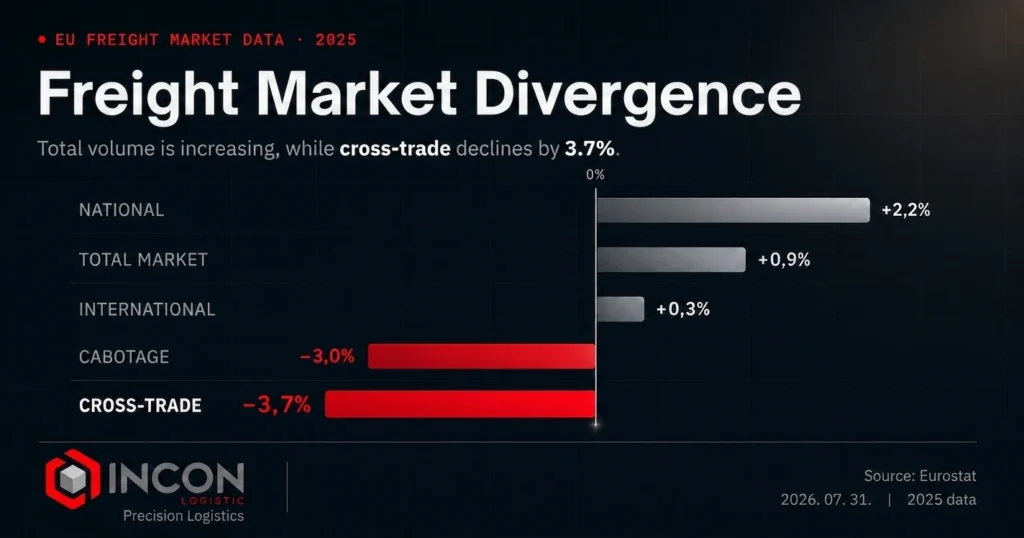
The latest logistics market data points to an apparent paradox. According to Eurostat’s newest release, published on 31 July 2026, total EU road freight transport grew by 0.9% in 2025 compared with the previous year – within this, national transport expanded by 2.2% and international transport by 0.3%. By contrast, the volume of cross-trade (transport carried out by hauliers from a third country, where neither the place of loading nor the place of unloading matches the carrier’s country of registration) fell by 3.7%, and cabotage declined by 3.0%.
What does this mean for the market, and why is this data critical from a supply chain optimisation perspective?
INCON-LOGISTIC’s experts see the following structural shifts behind these figures:
1. Regionalisation and the “Near-Shoring” Effect
The vulnerability of global supply chains – whether stemming from the experience of COVID-19 or from geopolitical tensions – is prompting shippers to bring production closer to their markets. One possible explanation for the decline is the regionalisation of European supply chains and the changing structure of production. Cross-trade is often part of long, complex, intercontinental chains, which are now shortening and giving way to more regionalised trade, such as intra-European flows.
2. Predictability and Risk Management
Cross-trade shipments – particularly on routes crossing several borders – carry greater exposure to freight-rate volatility, customs-clearance delays and administrative risk. In the current market environment, shippers are prioritising stability, even where this occasionally means paying a higher freight rate, steering them towards more dedicated, direct transport, such as intra-European freight.
3. The Paradox of Digitalisation and Optimisation
In our experience, advanced TMS (Transport Management System) platforms and AI-based optimisation software – which INCON LOGISTIC also uses in its day-to-day operations – give shippers and logistics providers an increasingly precise view of the entire supply chain. Carriers and logistics providers can now assess not only the freight rate, but also empty running, waiting time, road tolls, capacity utilisation, route planning and the likelihood of securing a return load.
This allows for more informed lane and partner selection, including for cross-trade shipments. Digitalisation, then, does not necessarily drive the decline of cross-trade – rather, it helps determine more precisely which freight tasks remain sustainable and profitable in the long run.
4. The Regulatory Environment
In recent years, several elements of the EU’s Mobility Package have tightened the operating conditions for cross-trade and cabotage transport.
As of 1 July 2026, a further significant regulatory step took effect: EU rules on driving and rest times, along with the obligation to use a smart tachograph, now also apply to light commercial vehicles above 2.5 tonnes engaged in international freight transport.
This particularly affects smaller-vehicle carriers that are also active in international and cross-trade lanes. The stricter compliance requirements can increase administrative and operational burdens, prompting some market players to rethink their freight structures and lanes.
What does all this mean for your business?
The market isn’t standing still, but the balance of power is shifting. INCON-LOGISTIC’s experts are ready to analyse your supply chain and help optimise your freight strategy in line with these evolving trends. Whether it’s the challenges brought on by regionalisation or the opportunities created by digital optimisation, we’re here to help you find the most effective solution.
Source: Eurostat, Road freight transport statistics, 31 July 2026.