INCON-LOGISTIC – Tailored solutions for individual needs
Tailor-made services are close to our heart. We are ready to help our partners at every point of the supply chain. Our dedicated, professional forwarding consultants work to be your company’s efficiency-enhancing engine for internal processes.
INCON-LOGISTIC – Sustainability and reduced environmental impact throughout our activities
Commitment to sustainable, green shipping is one of our core values. This has led us to joining the Lean & Green program of the logistics sector, which not only applies state-of-the-art solutions to effectively measure and analyse our carbon footprint but also develops proposals to reduce emissions. We have developed our own CO2 emission calculator to support our customers with data provision. We embrace partners that share similar values.
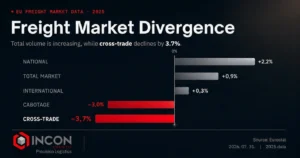
The latest logistics market data points to an apparent paradox. According to Eurostat’s newest release, published on 31 July 2026, total EU road freight transport grew by 0.9% in 2025 compared with the previous year – within this, national transport expanded by 2.2% and international transport by 0.3%.
On the fifth day of the Iran conflict, it is still unclear whether the situation will develop into a short, rapid military campaign — as some political leaders hope — or an extended conflict.
What is already clear, however, is that international freight transport is beginning to feel the effects.
Global logistics systems are highly sensitive to geopolitical tensions. The current situation is unfolding in a region that hosts one of the most critical maritime trade corridors in the world.
The team at INCON-LOGISTIC Kft. has summarized the most important developments.
From July 1, 2026, a new phase begins in European road transport regulation. Under EU rules, light commercial vehicles between 2.5 and 3.5 tonnes engaged in international freight transport will also be required to use a tachograph.
The period from 2022 to 2025 clearly showed that the transport market and road freight segments do not operate linearly. An initial growth momentum was followed by industrial slowdown, then signs of stabilization emerged — though not equally across all segments. In 2026, the question is not whether the market is difficult, but how each logistics player adapts to the changed environment.
Over the past months, more and more industries have begun to experience the impact of artificial intelligence. After software development, legal services and finance, freight forwarding and logistics are now firmly in focus.